
BLOG

Behind the numbers.

Code examples, market analysis, and data quality deep-dives.

Which Commodities Have the Strongest Momentum? Rotation Backtest in Python
Which Commodity ETFs Have the Worst Tail Risk? Expected Shortfall in Python
Are Gold Miners Leveraged Gold Bets? Rolling Beta Analysis in Python
Does the Base-Metals-to-Gold Ratio Lead Cyclical Stocks? Signal Test in Python
Can Risk Parity Tame Commodity Volatility? Portfolio Optimization in Python
Are Power Stocks Becoming an AI Infrastructure Trade? Momentum Screening in Python
Which AI Chip Stocks Have Margin Momentum? Profitability Trend Analysis in Python
Which AI Stocks Are Cheapest Relative to Growth? Growth-Adjusted Valuation in Python
Does AI Stock Leadership Persist? Momentum Backtest in Python
Which AI Stocks Have the Cleanest Balance Sheets? Net Cash Screening in Python
Can Risk Parity Reduce Mega-Cap Drawdowns? Portfolio Optimization in Python
Which Growth Stocks Are Self-Funding? Cash-Flow Quality Screening in Python
Which Sectors Struggle When the Dollar Rallies? Sector Rotation Analysis in Python
Do Cheap Stocks Hold Up When Bonds Sell Off? Valuation Rotation in Python
Does the Nasdaq 100 Have Better Growth Quality Than the Dow? Index Constituent Analysis in Python
Do Healthcare Cash-Flow Margins Predict Returns? Signal Evaluation in Python
Which Dividend Stocks Survive a Cash-Flow Stress Test? Dividend Screening in Python
Does Heavy Insider Selling Predict Weak Returns? Insider Flow Test in Python
Can Quality Screens Reduce Small-Cap Balance-Sheet Risk? Russell 2000 Test in Python
Which Retailers Have Positive Operating Leverage? Margin Screening in Python
Is MSTR a Leveraged Bitcoin Proxy? Rolling Beta Analysis in Python
Is Micron's Memory Cycle Recovering? Inventory and Margin Forecasting in Python
Which Sectors Work When Bonds Rally? Rate-Sensitive Rotation in Python
Do One-Month Price Extremes Reverse? Signal Evaluation in Python
Do Low-Volatility S&P 500 Stocks Reduce Drawdowns? Factor Test in Python
Is AI Capex Paying Back Fast Enough? Revenue Hurdle Forecasting in Python
Could Shorter AI Asset Lives Hit Earnings? Depreciation Stress Test in Python
How Much AI Capex Risk Can a Portfolio Remove? Constrained Optimization in Python
Is the AI Capex Trade Crowded? Rolling Volatility and Sector Rotation in Python
Did the AI Boom Come From Existing S&P 500 Members? Point-in-Time Momentum Test in Python
Is AI Revenue Circular? Customer-Vendor Capex Loop Analysis in Python
Is the AI Trade Connected to Private Credit? Rolling Correlation Network in Python
Is Apollo More Balance-Sheet Sensitive Than Peers? Leverage Screen in Python
Are AI Earnings Supported by Cash Flow? Accrual and Capex Screen in Python
Can Defensive Stocks Hedge AI Drawdowns? Basket Regime Test in Python
How Fast Does the Market Price In Fed Decisions? FOMC Event Study in Python
How Much Are Options Sellers Overpaid? The Variance Risk Premium in Python
Which Companies Have the Worst Earnings Quality? Sloan Accrual Screen with Geographic Revenue Data in Python
Does the Oil-to-Gold Ratio Signal Recessions? XLE/GLD Backtest in Python
Is AI Spending Crowding Out Free Cash Flow? Capex Sustainability Across the Mag 7 in Python
Does a Long Energy / Short Bonds Portfolio Capture Inflation Surprises? Factor Construction in Python
Can a Hidden Markov Model Detect Oil Market Regimes? HMM Analysis in Python
Do Grain Prices Predict Food Inflation? Granger Causality Test in Python
Does the Corporate Credit Spread Predict Stock Market Crashes? BAA-AAA Spread Analysis in Python
Do Oil Stocks Hedge Inflation? Rolling Beta Analysis in Python
Which Stocks Are Most Rate-Sensitive? Equity Duration via Bond Beta in Python
Which Companies Have the Highest Accrual Ratios? Earnings Quality Screening in Python
Is Alpha Persistent or Decaying? Rolling Sharpe Ratio Analysis in Python
Are Markets Trending or Mean-Reverting? Hurst Exponent Analysis in Python
Is Consumer Discretionary vs Staples a Leading Indicator? XLY/XLP Ratio Analysis in Python
Does Heavy Capex Predict Future Stock Returns? Capital Expenditure Analysis in Python
How to Estimate Cost of Equity Using CAPM in Python
Is Volatility Predictable? Testing for Volatility Clustering in Python
Which Industrials Are Overleveraged? Net Debt to EBITDA Screening in Python
GM Before and After Bankruptcy: Why Entity Resolution Matters for Financial Data
What Is Adjusted Beta? Merrill Lynch Beta Shrinkage in Python
How Good Is a Stock Pick? Information Ratio and Tracking Error in Python
Do Stock Returns Follow a Normal Distribution? Testing for Fat Tails in Python
Which Large Caps Have the Highest Free Cash Flow Yield? FCF Screening in Python
Which Sectors Won Over 5 Years? Sector Rotation Analysis in Python
How to Forecast Stock Volatility with GARCH Models in Python
Are Stock Prices Mean-Reverting? Augmented Dickey-Fuller Test in Python
How to Calculate CAPM Alpha and Beta with Regression in Python
How to Compare Sector Sharpe Ratios and Sortino Ratios in Python
DELL: Why Stitching Historical Price Data Together Is Wrong
How to Analyze Drawdown and Recovery for Bank Stocks in Python
How to Screen SaaS Stocks by Revenue Growth and Cash Flow in Python
How to Screen REITs by Dividend Yield and Valuation in Python
How Correlated Are the Magnificent 7? Intra-Group Correlation in Python
AAPL vs XOM: Do Individual Stocks Have Seasonal Patterns?
How to Rank Large-Cap Stocks by Momentum in Python
How to Build a Multi-Endpoint Financial Dashboard in Python
How to Compare Volatility Across Energy Stocks in Python
How to Screen Healthcare Stocks by Valuation in Python
How to Build a Sector Correlation Matrix for Portfolio Diversification in Python
How to Find Oversold and Overbought Stocks Using Z-Scores in Python
How to Measure Earnings Quality: Cash Flow vs Net Income in Python
How to Build a Multi-Factor Stock Screen in Python (Value + Momentum + Quality)
How to Build a Simple DCF Model for Any Stock in Python
How to Screen Tech Stocks by Revenue Growth in Python
How to Screen Stocks by Balance Sheet Health in Python
Is "Sell in May" Real? SPY Monthly Seasonality Over 10 Years
How to Compare Sector Performance YTD Using Python
How to Track S&P 500 Additions and Removals Over Time in Python
How to Screen Dividend Stocks by Yield and Quality in Python
How to Calculate Max Drawdown and Recovery Time for Any Stock in Python
How to Compare Profitability Across Mega-Cap Tech Stocks in Python
Why Ticker Symbols Are Unreliable: The Recycling Problem Every Quant Should Know
How to Calculate and Compare Stock Volatility in Python
How to Screen Blue-Chip Stocks by P/E Ratio in Python
How to Track Companies Through Ticker Changes, Bankruptcies, and Renames in Python
S&P 500 Turnover: How Much the Index Has Changed Since 2010
How to Calculate Stock Beta and Correlation in Python
← All articles

Does the Base-Metals-to-Gold Ratio Lead Cyclical Stocks? Signal Test in Python

What's the question?

Base metals are tied to industrial demand. Gold is more closely associated with real rates, inflation hedging, and defensive demand. The ratio of base metals to gold is therefore often treated as a compact cyclical signal. When base metals outperform gold, the market may be pricing stronger growth. When gold outperforms base metals, the market may be pricing caution.

The practical question is whether this ratio actually helps forecast equity returns. A plausible macro story is not enough. The signal must be tested against forward returns.

The question is whether a rising DBB/GLD ratio leads stronger subsequent returns for cyclically exposed equities.

The approach

The signal is the six-month change in DBB divided by GLD. The forward returns are measured for XLI, XLB, and SPY. Built from SEC EDGAR public filings and market data, the test uses ten years of monthly observations.

  1. Pull ten years of daily prices and returns for DBB, GLD, XLI, XLB, and SPY
  2. Convert daily data to complete monthly observations
  3. Compute the six-month percentage change in DBB/GLD
  4. Sort each monthly signal into quintiles
  5. Measure average next-three-month returns for XLI, XLB, and SPY

XLI and XLB are included because industrials and materials should be more sensitive to cyclical commodity signals than the broad market.

Code

import xfinlink as xfl
import pandas as pd
import numpy as np

xfl.set_api_key("YOUR_API_KEY")  # free at https://xfinlink.com/signup

tickers = ["DBB", "GLD", "XLI", "XLB", "SPY"]
prices = xfl.prices(tickers, period="10y", fields=["adj_close", "return_daily"])

price_daily = prices.pivot_table(index="date", columns="ticker", values="adj_close").dropna()
return_daily = prices.pivot_table(index="date", columns="ticker", values="return_daily").dropna()

monthly_prices = price_daily.resample("ME").last()
monthly_returns = (1 + return_daily).resample("ME").prod() - 1

signal = (monthly_prices["DBB"] / monthly_prices["GLD"]).pct_change(6)
forward_spy = (1 + monthly_returns["SPY"]).rolling(3).apply(np.prod, raw=True).shift(-3) - 1

analysis = pd.DataFrame({"signal": signal, "forward_spy": forward_spy}).dropna()
analysis["quintile"] = pd.qcut(analysis["signal"], 5)

print(analysis.groupby("quintile", observed=False)["forward_spy"].mean())

Full script with formatting and visualisation: base-metals-gold-cyclical-signal-python.py

Output
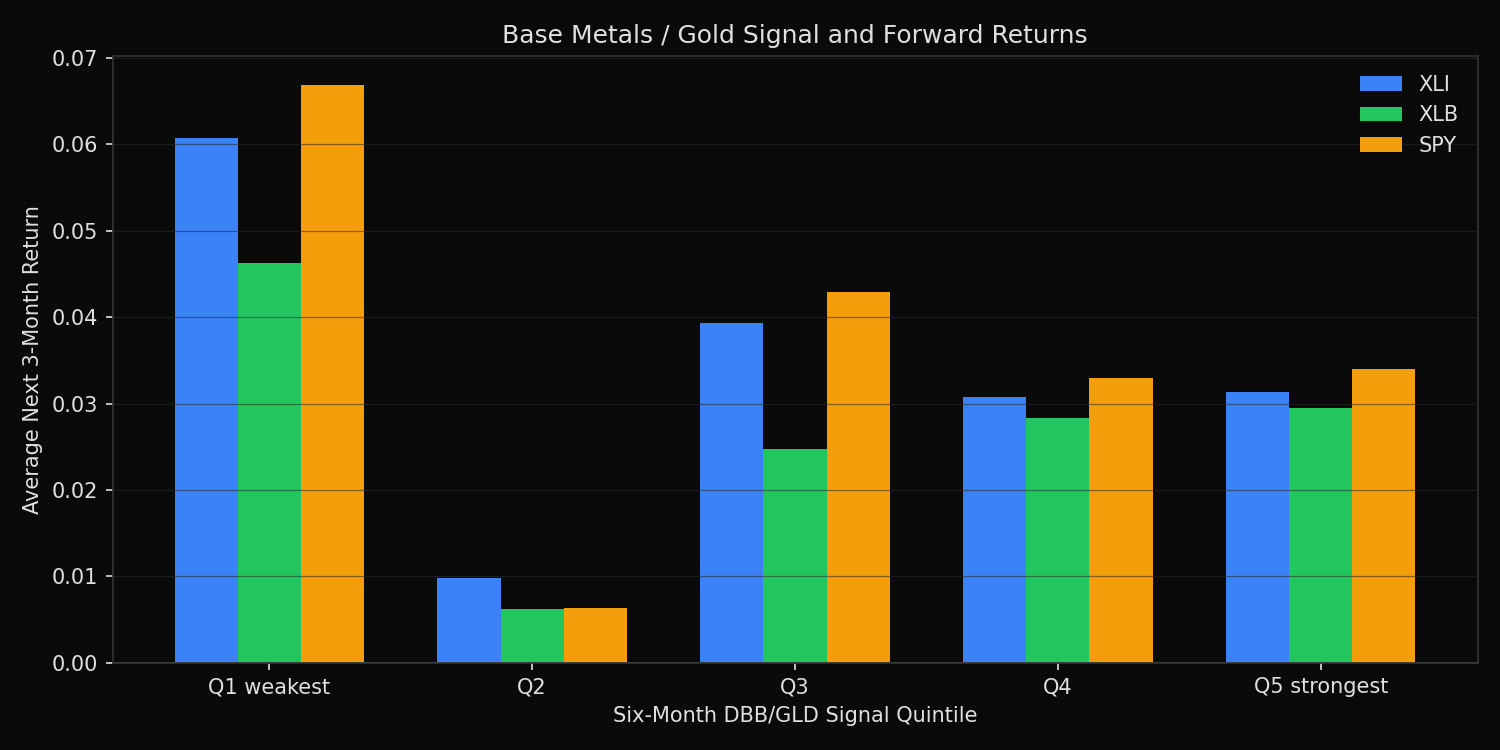
Forward three-month XLI XLB and SPY returns by DBB to GLD signal quintile
=== Base-Metals-to-Gold Cyclical Signal ===
Signal: 6-month change in DBB/GLD
Forward return window: next 3 months
Sample: 2016-12-31 to 2026-02-28 (111 monthly observations)
Latest signal:  +9.9% (Q5 strongest)

Average next 3-month returns by signal quintile:
Q1 weakest    n=23  XLI= +6.1%  XLB= +4.6%  SPY= +6.7%
Q2            n=22  XLI= +1.0%  XLB= +0.6%  SPY= +0.6%
Q3            n=22  XLI= +3.9%  XLB= +2.5%  SPY= +4.3%
Q4            n=22  XLI= +3.1%  XLB= +2.8%  SPY= +3.3%
Q5 strongest  n=22  XLI= +3.1%  XLB= +3.0%  SPY= +3.4%

Strong-minus-weak signal spread:
XLI spread= -2.9%
XLB spread= -1.7%
SPY spread= -3.3%

What this tells us

The result does not support a simple pro-cyclical interpretation. The weakest DBB/GLD signal quintile had the strongest forward returns: XLI averaged +6.1%, XLB averaged +4.6%, and SPY averaged +6.7% over the next three months.

The strongest signal quintile was still positive, but it did not lead. Q5 averaged +3.1% for XLI, +3.0% for XLB, and +3.4% for SPY. The strong-minus-weak spreads were negative across all three assets.

This pattern is closer to a contrarian signal than a trend-confirmation signal. When base metals have already outperformed gold sharply, part of the cyclical optimism may already be priced. When the ratio is weak, forward returns have historically been stronger in this sample.

So what?

The base-metals-to-gold ratio is useful, but not as a direct buy signal for cyclicals. A rising ratio may confirm improving cyclical sentiment, yet the forward-return evidence does not justify chasing that move mechanically.

For market timing, the better use is conditional. A weak ratio can identify periods when cyclicals are out of favor and forward returns may be more attractive. A strong ratio can confirm the macro backdrop, but it should be paired with valuation, earnings revisions, or momentum breadth before increasing risk.

Built with xfinlink — free financial data API for Python. pip install xfinlink

Built with xfinlink — free financial data API for Python. pip install xfinlink
← All articles