
What’s the question?
Oil prices rise with economic activity. Gold prices rise with fear, uncertainty, and inflation hedging. The ratio of oil to gold (proxied by XLE/GLD) captures the market’s relative assessment of growth vs risk aversion. When the ratio falls sharply — oil underperforming gold — the market is pricing in weakening growth and rising risk premiums simultaneously. If this ratio carries forward-looking information, its rate of change should predict subsequent equity market performance. A DBB/GLD signal study tests base metals over gold, a close relative of this ratio, against cyclical sector funds and SPY.
The approach
10 years of XLE, GLD, and SPY. Compute the 12-month rate of change in XLE/GLD, sort into quintiles, measure mean forward 6-month SPY total return per quintile.
import xfinlink as xfl
import pandas as pd
import numpy as np

xfl.api_key = "YOUR_API_KEY"  # free at https://xfinlink.com/signup

# 10 years of XLE, GLD, SPY
tickers = ["XLE", "GLD", "SPY"]
df = xfl.prices(tickers, start="2016-01-01", fields=["close"])
df["date"] = pd.to_datetime(df["date"])

# Pivot to wide format
wide = df.pivot_table(index="date", columns="ticker", values="close")
wide = wide.dropna()

# Compute XLE/GLD ratio and 12-month rate of change
wide["ratio"] = wide["XLE"] / wide["GLD"]
wide["ratio_roc_12m"] = wide["ratio"].pct_change(252)

# Forward 6-month SPY return
wide["fwd_6m"] = wide["SPY"].pct_change(126).shift(-126)

# Drop NaN and bin into quintiles
analysis = wide.dropna(subset=["ratio_roc_12m", "fwd_6m"]).copy()
analysis["quintile"] = pd.qcut(analysis["ratio_roc_12m"], 5,
                                labels=["Q1 (Falling)", "Q2", "Q3", "Q4", "Q5 (Rising)"])

print(f"Current XLE/GLD ratio: {wide['ratio'].iloc[-1]:.3f}")
print(f"12-month change: {wide['ratio_roc_12m'].iloc[-1]*100:+.1f}%\n")

for q in ["Q1 (Falling)", "Q2", "Q3", "Q4", "Q5 (Rising)"]:
    sub = analysis[analysis["quintile"] == q]
    print(f"{q:14s}  fwd_ret={sub['fwd_6m'].mean()*100:+.1f}%  n={len(sub)}")
Full script with formatting and visualisation: oil-gold-ratio-recession-signal-python.py
Output:
Current XLE/GLD ratio: 0.139
12-month change: -47.5%

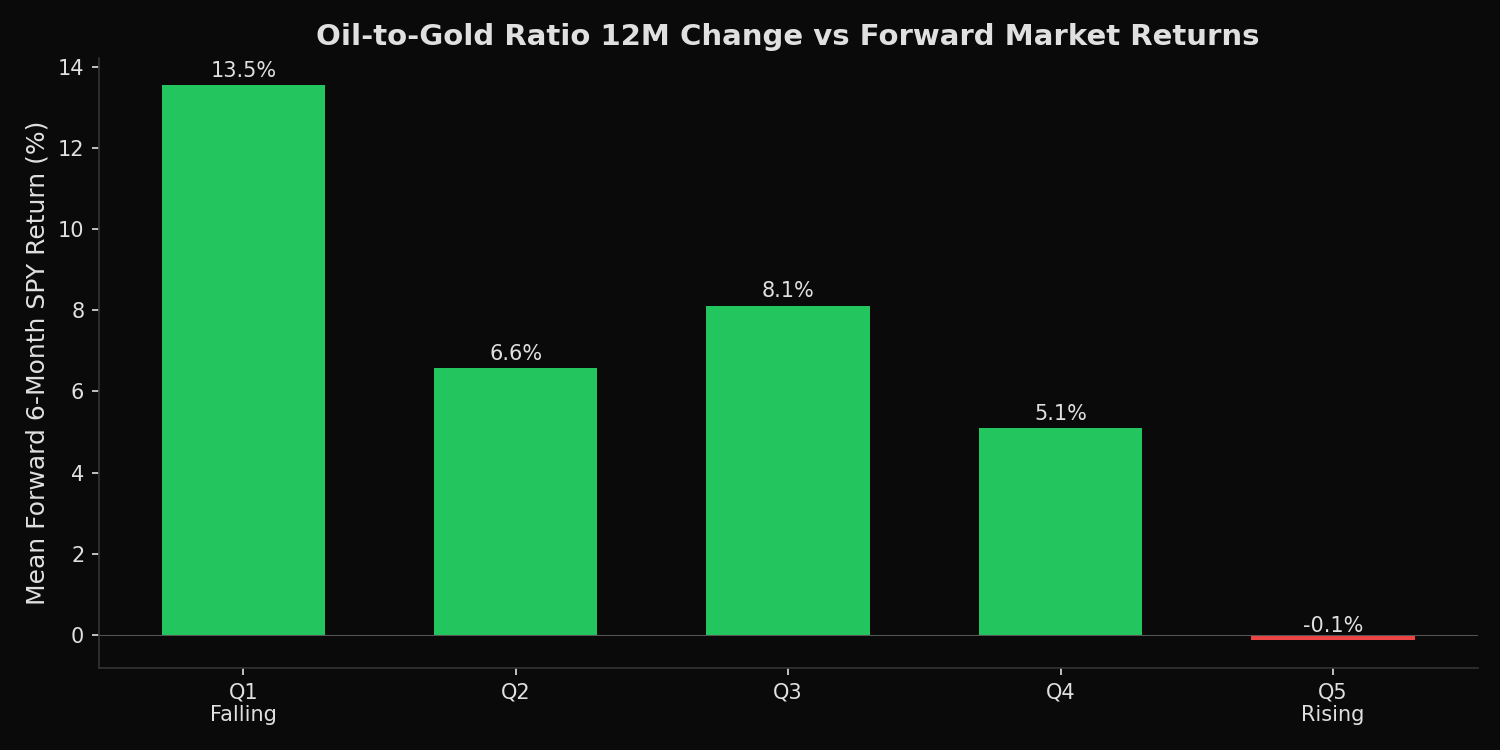
Q1 (Falling)   fwd_ret=+13.5%  n=444
Q2             fwd_ret=+6.6%   n=444
Q3             fwd_ret=+8.1%   n=443
Q4             fwd_ret=+5.1%   n=444
Q5 (Rising)    fwd_ret=-0.1%   n=444
What this tells us
The result is contrarian. When the oil-to-gold ratio is falling fastest (Q1) — indicating gold outperforming oil, a risk-off environment — forward 6-month SPY returns average +13.5%. This is the strongest quintile by far. When the ratio is rising fastest (Q5) — oil outperforming gold, a risk-on environment — forward returns are essentially zero (-0.1%). The interpretation: extreme risk-off conditions (falling ratio) tend to precede recoveries, while extreme risk-on conditions (rising ratio) tend to precede mean reversion. The current 12-month change of -47.5% places the market deep in Q1 territory.
So what?
The XLE/GLD ratio is a contrarian macro indicator, not a trend-following one. A sharply falling ratio (gold outperforming oil) historically precedes strong equity returns over the next 6 months. A sharply rising ratio historically precedes flat-to-negative returns. For tactical allocation, a 12-month decline exceeding -30% in the ratio is a historically favorable entry point for equities. A 12-month increase exceeding +30% is a signal to reduce risk. Consumer discretionary against staples offers a sector-based reading of the same idea, tested in an XLY/XLP leading-indicator study.