Which AI Stocks Have the Cleanest Balance Sheets? Net Cash Screening in Python
June 17, 2026
What's the question?
AI growth is capital intensive. Companies are buying chips, building data centers, funding model development, and expanding sales capacity. That spending is easier to absorb when the balance sheet has cash, low debt, and strong free cash flow.
Net cash is cash and short-term investments minus total debt. Positive net cash means a company could repay all debt with cash on hand and still have cash remaining. Negative net cash does not automatically mean distress, but it increases the importance of cash generation and refinancing conditions.
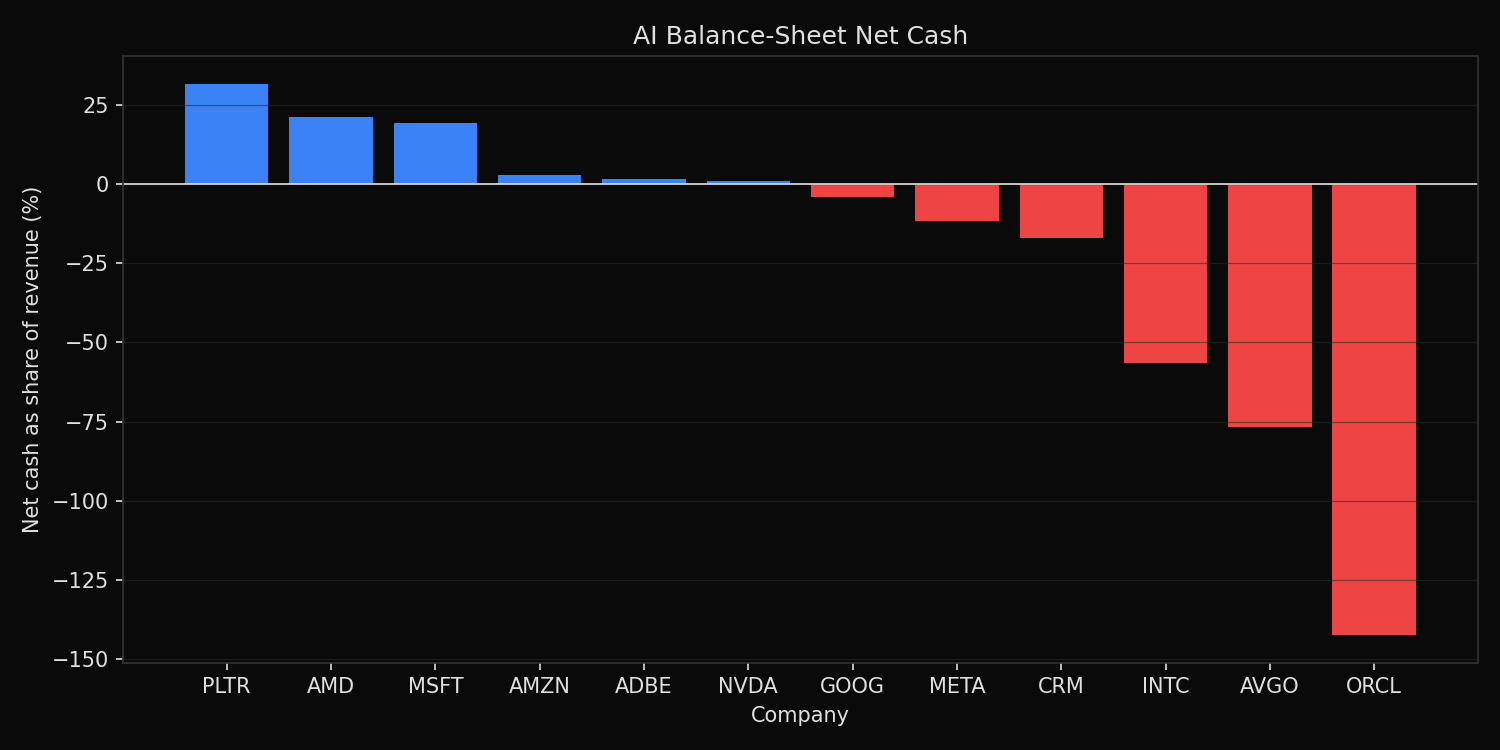
The question is which AI-linked companies have the cleanest balance sheets, and which carry the largest net debt burden relative to revenue.
The approach
The universe is NVDA, AVGO, AMD, PLTR, MSFT, META, GOOG, AMZN, ORCL, ADBE, INTC, and CRM. Built from SEC EDGAR public filings and market data, the screen uses latest annual balance-sheet and cash-flow data.
- Pull revenue, cash, debt, total assets, free cash flow, operating income, and interest expense
- Compute net cash as cash minus total debt
- Scale net cash by revenue so companies of different sizes can be compared
- Compute debt-to-assets, free-cash-flow margin, and interest coverage
- Rank companies by net cash as a share of revenue
Interest coverage is operating income divided by interest expense. Higher values indicate more ability to absorb interest costs from current operations.
Code
import xfinlink as xfl
import pandas as pd

xfl.set_api_key("YOUR_API_KEY")  # free at https://xfinlink.com/signup

tickers = ["NVDA", "AVGO", "AMD", "PLTR", "MSFT", "META", "GOOG", "AMZN", "ORCL", "ADBE", "INTC", "CRM"]
fields = ["revenue", "cash_and_short_term_investments", "total_debt",
          "total_assets", "free_cash_flow", "operating_income", "interest_expense"]

df = xfl.fundamentals(tickers, period_type="annual", period="3y", fields=fields)
latest = df.sort_values(["ticker", "period_end"]).groupby("ticker").tail(1).set_index("ticker")

latest["net_cash"] = latest["cash_and_short_term_investments"] - latest["total_debt"].fillna(0)
latest["net_cash_to_revenue"] = latest["net_cash"] / latest["revenue"]
latest["debt_to_assets"] = latest["total_debt"].fillna(0) / latest["total_assets"]
latest["fcf_margin"] = latest["free_cash_flow"] / latest["revenue"]

print(latest.sort_values("net_cash_to_revenue", ascending=False))
Full script with formatting and visualisation: ai-balance-sheet-net-cash-python.py
Output
=== AI Balance-Sheet Net Cash Screen ===
Universe: 12 AI platform, software, and semiconductor stocks
Latest annual periods: 2025-05-31 to 2026-01-31
Highest net cash / revenue: PLTR (+31.8%)
Lowest net cash / revenue: ORCL (-142.5%)

Balance-sheet ranking:
PLTR  cash=$1.4B  debt=$0.0B  net_cash=$1.4B  net_cash/revenue=+31.8%  debt/assets= 0.0%  FCF_margin=46.9%  interest_cover=No interest expense
AMD   cash=$10.6B  debt=$3.2B  net_cash=$7.3B  net_cash/revenue=+21.2%  debt/assets= 4.2%  FCF_margin=19.4%  interest_cover= 28.2x
MSFT  cash=$94.6B  debt=$40.2B  net_cash=$54.4B  net_cash/revenue=+19.3%  debt/assets= 6.5%  FCF_margin=25.4%  interest_cover= 53.9x
AMZN  cash=$86.8B  debt=$66.1B  net_cash=$20.7B  net_cash/revenue= +2.9%  debt/assets= 8.1%  FCF_margin= 1.1%  interest_cover= 35.2x
ADBE  cash=$6.6B  debt=$6.2B  net_cash=$0.4B  net_cash/revenue= +1.6%  debt/assets=21.1%  FCF_margin=41.4%  interest_cover= 33.1x
NVDA  cash=$10.6B  debt=$8.5B  net_cash=$2.1B  net_cash/revenue= +1.0%  debt/assets= 4.1%  FCF_margin=44.8%  interest_cover=503.4x
GOOG  cash=$30.7B  debt=$46.5B  net_cash=$-15.8B  net_cash/revenue= -3.9%  debt/assets= 7.8%  FCF_margin=18.2%  interest_cover=175.3x
META  cash=$35.9B  debt=$59.0B  net_cash=$-23.1B  net_cash/revenue=-11.5%  debt/assets=16.1%  FCF_margin=22.9%  interest_cover= 76.4x
CRM   cash=$7.3B  debt=$14.4B  net_cash=$-7.1B  net_cash/revenue=-17.1%  debt/assets=12.9%  FCF_margin=34.7%  interest_cover= 25.7x
INTC  cash=$14.3B  debt=$44.1B  net_cash=$-29.8B  net_cash/revenue=-56.4%  debt/assets=20.9%  FCF_margin=-9.4%  interest_cover= -2.0x
AVGO  cash=$16.2B  debt=$65.1B  net_cash=$-49.0B  net_cash/revenue=-76.6%  debt/assets=38.1%  FCF_margin=42.1%  interest_cover=  7.9x
ORCL  cash=$10.8B  debt=$92.6B  net_cash=$-81.8B  net_cash/revenue=-142.5%  debt/assets=55.0%  FCF_margin=-0.7%  interest_cover=  4.9x
What this tells us
PLTR, AMD, and MSFT have the cleanest balance sheets by this screen. PLTR has no debt in the latest annual data and net cash equal to 31.8% of revenue. AMD has net cash equal to 21.2% of revenue, while MSFT has 19.3% despite its much larger scale.
NVDA ranks near the middle by net cash, but its risk profile is stronger than the ranking alone suggests. Debt is only 4.1% of assets, free-cash-flow margin is 44.8%, and interest coverage is 503.4x. The balance sheet is not cash-heavy relative to revenue, but the business is highly cash-generative.
ORCL, AVGO, and INTC sit at the bottom for different reasons. ORCL has net cash equal to -142.5% of revenue and debt equal to 55.0% of assets. AVGO has high leverage but also a 42.1% free-cash-flow margin. INTC has negative free-cash-flow margin and negative interest coverage, making its leverage more concerning.
So what?
Balance-sheet quality matters because AI spending is not a one-year project. Companies with net cash and high free-cash-flow margins can keep investing through downturns. Companies with large net debt need operating cash flow to stay strong, especially if rates or refinancing conditions become less favorable.
The screen suggests a practical risk framework. Net cash names can be evaluated primarily on growth durability and valuation. Levered names need an additional credit and cash-flow review. A high-growth AI company with weak balance-sheet capacity may still be attractive, but it has a higher required return because the margin for error is smaller.
Built with xfinlink — free financial data API for Python. pip install -U xfinlink
pip install -U xfinlink