
Which AI Stocks Are Cheapest Relative to Growth? Growth-Adjusted Valuation in Python
June 17, 2026
What's the question?
Artificial intelligence stocks often look expensive on simple valuation ratios. A high P/E ratio can be justified if earnings and revenue are growing quickly, but the comparison has to be explicit. Otherwise every fast-growing company can be described as expensive or cheap depending on the narrative.
This screen uses a growth-adjusted P/E ratio: P/E divided by trailing-twelve-month revenue growth measured in percentage points. A lower number means investors are paying fewer P/E turns for each point of revenue growth. This is not a full intrinsic value model. It is a compact way to compare growth and valuation in the same table.
The question is which AI-linked stocks look cheapest relative to current growth, and which require the most confidence in future expansion.
The approach
The universe is NVDA, AVGO, AMD, PLTR, MSFT, META, GOOG, AMZN, ORCL, and ADBE. Built from SEC EDGAR public filings and market data, the screen uses latest trailing-twelve-month metrics.
- Pull market capitalization, revenue growth, P/E ratio, price-to-free-cash-flow, and free-cash-flow margin
- Require positive revenue growth and a positive P/E ratio
- Divide P/E by revenue growth in percentage points
- Compute free-cash-flow yield as the inverse of price-to-free-cash-flow
- Rank companies by growth-adjusted P/E
Free-cash-flow yield is included because growth without cash conversion can be fragile. Negative free-cash-flow yield indicates that trailing free cash flow is negative.
Code
import xfinlink as xfl
import pandas as pd

xfl.set_api_key("YOUR_API_KEY")  # free at https://xfinlink.com/signup

tickers = ["NVDA", "AVGO", "AMD", "PLTR", "MSFT", "META", "GOOG", "AMZN", "ORCL", "ADBE"]
fields = ["market_cap", "revenue_growth", "pe_ratio", "price_to_fcf", "fcf_margin"]
df = xfl.metrics(tickers, period_type="ttm", fields=fields)
latest = df.sort_values("period_end").groupby("ticker").tail(1).set_index("ticker")

latest["growth_adjusted_pe"] = latest["pe_ratio"] / (latest["revenue_growth"] * 100)
latest["fcf_yield"] = 1 / latest["price_to_fcf"]

print(latest.sort_values("growth_adjusted_pe"))
Full script with formatting and visualisation: ai-growth-valuation-screen-python.py
Output
=== AI Growth-Adjusted Valuation Screen ===
Universe: 10 AI platform, software, and semiconductor stocks
Latest TTM periods: 2026-02-28 to 2026-05-29
Lowest P/E per revenue-growth point: NVDA (0.45)
Highest free-cash-flow yield: ADBE (+12.4%)

Valuation ranking:
NVDA  market_cap=$5,019.3B  rev_growth=+70.7%  PE=  31.8  PE/growth_pt= 0.45  P/FCF=   42.1  FCF_yield= +2.4%  FCF_margin=47.0%
META  market_cap=$1,520.9B  rev_growth=+26.2%  PE=  21.8  PE/growth_pt= 0.83  P/FCF=   31.5  FCF_yield= +3.2%  FCF_margin=22.4%
ADBE  market_cap=$82.7B  rev_growth=+11.5%  PE=  11.9  PE/growth_pt= 1.03  P/FCF=    8.1  FCF_yield=+12.4%  FCF_margin=40.8%
MSFT  market_cap=$2,925.8B  rev_growth=+17.9%  PE=  23.4  PE/growth_pt= 1.31  P/FCF=   40.1  FCF_yield= +2.5%  FCF_margin=22.9%
GOOG  market_cap=$4,522.3B  rev_growth=+17.5%  PE=  28.5  PE/growth_pt= 1.63  P/FCF=   70.2  FCF_yield= +1.4%  FCF_margin=15.2%
AMZN  market_cap=$2,645.5B  rev_growth=+14.2%  PE=  29.4  PE/growth_pt= 2.07  P/FCF=-1070.2  FCF_yield= -0.1%  FCF_margin=-0.3%
AVGO  market_cap=$1,792.4B  rev_growth=+30.0%  PE=  62.7  PE/growth_pt= 2.09  P/FCF=   54.7  FCF_yield= +1.8%  FCF_margin=43.4%
PLTR  market_cap=$319.4B  rev_growth=+67.7%  PE= 149.7  PE/growth_pt= 2.21  P/FCF=  118.8  FCF_yield= +0.8%  FCF_margin=51.5%
ORCL  market_cap=$541.4B  rev_growth=+14.9%  PE=  33.8  PE/growth_pt= 2.27  P/FCF=  -21.9  FCF_yield= -4.6%  FCF_margin=-38.6%
AMD   market_cap=$826.9B  rev_growth=+35.0%  PE= 166.3  PE/growth_pt= 4.76  P/FCF=   96.4  FCF_yield= +1.0%  FCF_margin=22.9%
What this tells us
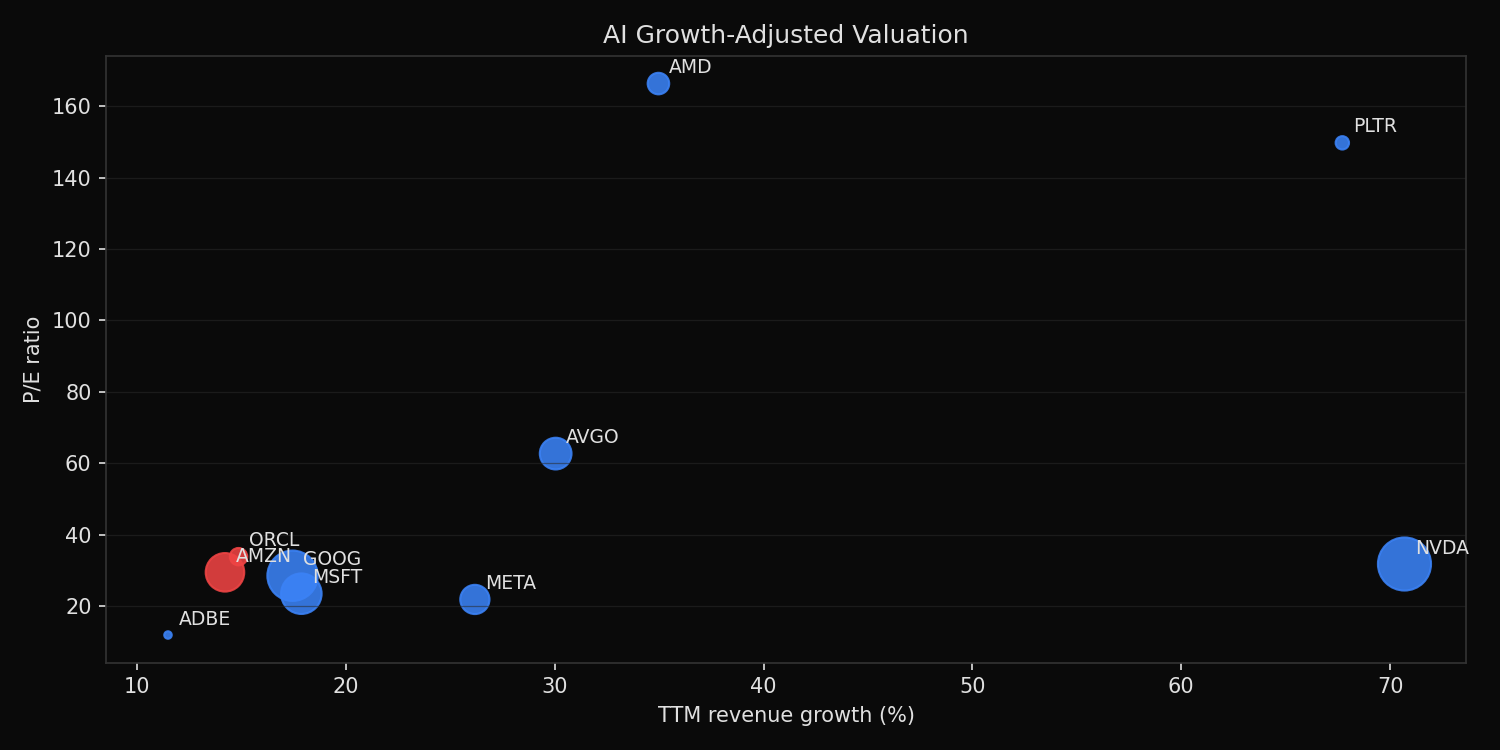
NVDA has the lowest growth-adjusted P/E in the group. Its P/E is 31.8, but revenue growth is 70.7%, producing a P/E per growth point of 0.45. META ranks second at 0.83, combining 26.2% revenue growth with a 21.8 P/E ratio.
ADBE ranks third even though its revenue growth is only 11.5%. Its valuation is low enough, and its free-cash-flow yield is high enough, to keep it competitive on this screen. It has the highest free-cash-flow yield in the group at 12.4%.
PLTR and AMD sit near the expensive end of the screen for different reasons. PLTR has very high growth, but the P/E ratio is also very high. AMD has strong revenue growth, but the P/E ratio is even higher relative to that growth. AMZN and ORCL require separate cash-flow analysis because their trailing free-cash-flow yields are negative in this window.
So what?
Growth-adjusted valuation is a triage tool. It does not replace discounted cash-flow work, but it identifies where deeper work is most justified. Low growth-adjusted P/E with positive free cash flow is a stronger starting point than low growth-adjusted P/E alone.
For AI portfolios, the useful distinction is between expensive growth and cash-generating growth. NVDA, META, MSFT, ADBE, and AVGO all have positive free-cash-flow yields. PLTR has exceptional growth but a much higher valuation burden. AMZN and ORCL need evidence that current investment spending converts back into cash flow. The screen turns that debate into a measurable hurdle.
Built with xfinlink — free financial data API for Python. pip install -U xfinlink
pip install -U xfinlink